Worlds in Harmony by His Holiness The Dalai Lama
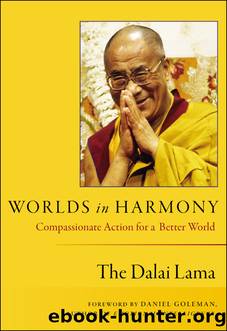
Author:His Holiness The Dalai Lama [Lama, Dalai; Goleman, Daniel]
Language: eng
Format: epub
ISBN: 9781935209409
Publisher: Parallax Press
6:Effective Action
EVEN IF we have a sense of universal responsibility, in the beginning of Buddhist practice, our ability to serve others is limited. The emphasis is on healing ourselves and transforming our mind and heart. But as we continue, we become stronger and increasingly able to serve others. But until that time, we may get overwhelmed by the suffering and difficulties of other people. We may become exhausted and not able to serve others effectively, not to mention ourselves. So we must begin simply by doing as well as we can, trying to improve ourselves, and, at the same time, trying as much as we can to serve other people. It is natural to feel some limitation with both, and we just have to accept that.
There are different approaches. We may engage in meditation, even over many years, with the simple motivation of wanting to improve ourselves. âI want to attain liberation. I want to overcome the afflictions of my mind.â In the context of bodhisattva practice, however, the emphasis is to be of service to others. In the course of being actively engaged in serving others, if our own personal practice diminishes a little, we can say, âIt was worthwhile because I was of some service.â
It is not enough to be compassionate. You must act. There are two aspects to action. One is to overcome the distortions and afflictions of your own mind, that is, in terms of calming and eventually dispelling anger and so forth. This is action born from compassion. The other is more social, more public. When there is something that needs to be done in the world to rectify wrongs, if one is really concerned with benefiting others, it is not enough simply to be compassionate. There is no direct benefit in that. With compassion, one needs to be engaged, involved.
Some people do not see the opportunity or do not have the ability to serve. From a Buddhist perspective, it is that very limitation that is an incentive for spiritual practice. It varies from individual to individual whether to serve. There are various propensities and inclinations, and there is also short-term effectiveness and long-term effectiveness. The situation is complex.
It really comes down to motivation. If you can proceed in service with the purest of motivation, then no matter what comes, you can proceed sincerely and without any regret. In my own case, there is no clear criterion. Whether I am meeting with a large group of people or a few individuals, in each case I try with sincerity and pure motivation to be of the greatest service I can. How effective it is, in the short term or in the long term, there is no way to tell. All I can do is engage with complete sincerity. Then, whatever happens, there is no regret.
Sometimes you see those who, despite very sincere motivation, hesitate too much. That is an obstacle. While you are idling in hesitation, trying over and over to decide what to do, the opportunity may be lost.
Download
This site does not store any files on its server. We only index and link to content provided by other sites. Please contact the content providers to delete copyright contents if any and email us, we'll remove relevant links or contents immediately.
| Anthropology | Archaeology |
| Philosophy | Politics & Government |
| Social Sciences | Sociology |
| Women's Studies |
The Secret History by Donna Tartt(19092)
The Social Justice Warrior Handbook by Lisa De Pasquale(12191)
Thirteen Reasons Why by Jay Asher(8912)
This Is How You Lose Her by Junot Diaz(6889)
Weapons of Math Destruction by Cathy O'Neil(6281)
Zero to One by Peter Thiel(5802)
Beartown by Fredrik Backman(5759)
The Myth of the Strong Leader by Archie Brown(5509)
The Fire Next Time by James Baldwin(5449)
How Democracies Die by Steven Levitsky & Daniel Ziblatt(5219)
Promise Me, Dad by Joe Biden(5154)
Stone's Rules by Roger Stone(5088)
A Higher Loyalty: Truth, Lies, and Leadership by James Comey(4964)
100 Deadly Skills by Clint Emerson(4927)
Rise and Kill First by Ronen Bergman(4790)
Secrecy World by Jake Bernstein(4753)
The David Icke Guide to the Global Conspiracy (and how to end it) by David Icke(4720)
The Farm by Tom Rob Smith(4514)
The Doomsday Machine by Daniel Ellsberg(4490)
